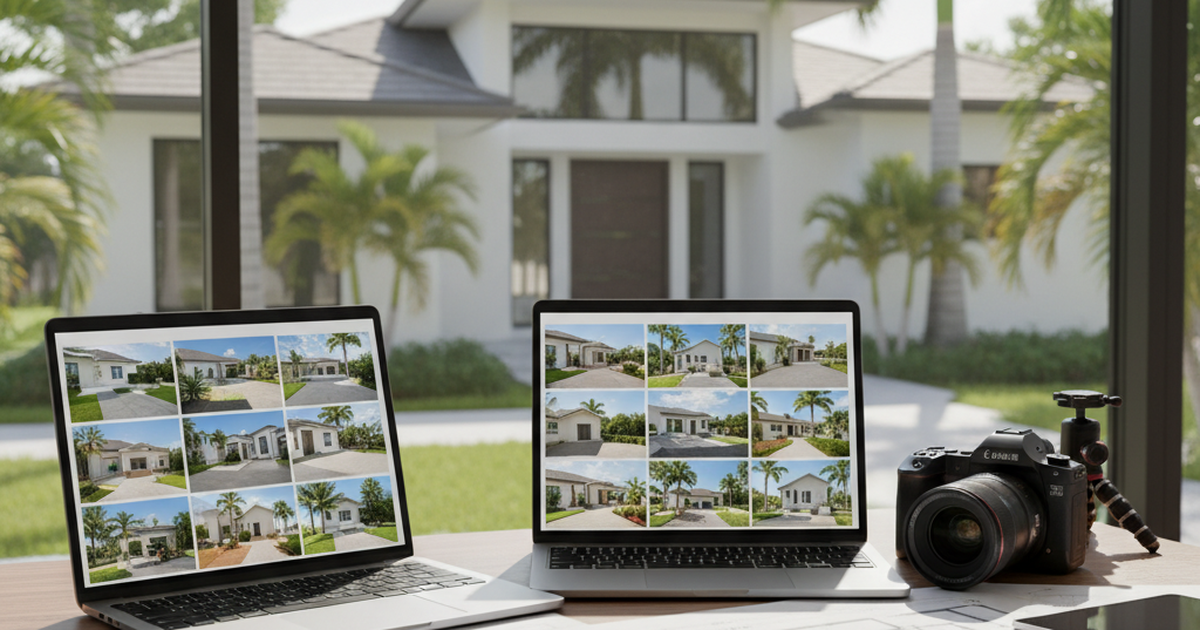
Florida agents are entering the 2026 selling season with a sharper problem than "better photos." Buyers have more tools, more online comparison points, more concern about affordability, and more reason to question whether a listing looks the same in person as it looked on a screen. That makes photo authenticity a business issue, not just a creative preference.
The strongest listing media in 2026 is not the most dramatic version of a home. It is the most useful version: clear HDR photography, accurate color, honest exposure, sensible composition, documented edits, and add-on media that helps a buyer understand the property before scheduling a showing. When a market is moving quickly, that trust can protect the agent's reputation, reduce wasted showings, and make the seller's presentation feel more professional.
This matters especially in Florida. Florida Realtors reported that the statewide median sale price for single-family existing homes reached $420,000 in April 2026, up 1.8% year over year, while condo-townhouse median pricing held at $315,000. The same April report showed a 4.7-month supply for single-family homes and an 8.9-month supply for condo-townhouse properties [1]. Buyers are comparing real options, not just browsing dream homes. If listing media exaggerates a view, hides a defect, changes a floor plan, or makes a room feel materially different from reality, the disappointment shows up in the showing feedback, negotiation, inspection period, and agent relationship.
Professional media still has to make a listing look its best. The line is simple: improve clarity without changing the truth of the property.
Why authenticity is now part of listing strategy
The buyer journey is heavily visual before it is physical. iGUIDE's 2026 real estate photography industry outlook says buyer behavior is shifting quickly, citing 74% of buyers starting online and professional photos driving 61% more views and 50% faster sales [2]. Those figures point to a practical reality every Florida agent already feels: the first showing often happens on a phone.
That first impression can help or hurt. Good HDR photography makes the home easier to read. It balances bright windows with interior detail, shows room flow, avoids muddy shadows, and presents finishes in a way that feels natural. That is very different from editing that changes the condition or perceived value of the home. A clean HDR process should show what is there with better technical control. It should not create a different property.
The distinction is becoming more important because buyers are aware that images can be manipulated. NAR's February 2026 REALTOR Magazine article on "catfishing" buyers with picture-perfect real estate photos warned that AI-powered photo tools, filters, wide-angle choices, and virtual staging can create expectations that fail once the buyer walks in the door [3]. NAR also highlighted that disclosure laws are beginning to surface around the country, including California's 2026 requirement for digitally altered real estate images to be disclosed with access to the original image [3].
Florida agents do not need to wait for a Florida-specific image law to treat transparency as a standard. A practical visual media workflow should already answer three questions before a listing goes live:
Does the image reflect the property as a buyer will experience it in person?
If the image is virtually staged or materially altered, is that clear to the buyer?
Can the agent and vendor produce the original file if a broker, seller, MLS, buyer, or attorney asks what changed?
That is not fear-based marketing. It is operational discipline.
What counts as helpful editing versus risky alteration?
Most real estate photos require editing. Raw images often need exposure balancing, vertical correction, lens correction, color adjustment, window pulls, and sharpening. Those changes help the camera represent what the human eye can understand in the space. In Florida interiors, HDR is especially useful because strong sunlight can make windows blow out while shaded rooms look darker than they are. A professional editor can recover both the interior and exterior context so the buyer can understand the room.
Risk increases when edits change the property rather than clarify it. California's AB 723 analysis gives a useful framework even for agents outside California. The bill defines digitally altered images as still photos changed with editing software or artificial intelligence to add, remove, or change elements of real property, including furniture, appliances, flooring, walls, paint color, hardscape, landscape, facade details, floor plans, and outside elements visible from the property. The analysis also distinguishes common photographic corrections like lighting, white balance, straightening, cropping, exposure, and color correction when they do not change the condition of the real property [4].
That distinction gives Florida listing teams a clean internal rule. Basic corrections are part of professional presentation. Material changes need disclosure and documentation.
Examples of low-risk professional corrections include:
Balancing interior and exterior exposure in an HDR image.
Correcting vertical lines so walls do not lean.
Adjusting white balance so cabinetry, flooring, and paint color look natural.
Cropping for composition without hiding relevant property conditions.
Removing temporary camera artifacts such as dust spots or lens flare.
Examples that should trigger a review before use include:
Replacing a brown lawn with green grass.
Removing power lines, neighboring structures, traffic, stains, wall damage, roof damage, or visible defects.
Changing flooring, countertops, paint color, appliances, fixtures, or built-ins.
Adding furniture without labeling the image as virtually staged.
Editing a window view, water view, golf course view, or skyline view.
Using AI to generate a room, elevation, amenity, or community feature that does not exist.
The point is not that every edit is forbidden. The point is that buyers should know when an image is showing a possible design scenario instead of the current property condition.
Florida's 2026 market makes trust more valuable
In a hotter seller's market, weak media can sometimes hide behind urgency. In a more balanced market, buyers scrutinize. Florida's April 2026 data shows a market with activity, but not a market where every listing can rely on scarcity alone. Florida Realtors reported more closed sales and rising new pending sales in April, including an 8% year-over-year increase in new pending sales for single-family homes and nearly 15% growth for condos and townhouses [1]. That is encouraging activity, but it is still a market where pricing, condition, insurance, HOA costs, and property type matter.
NAR's 2025 Profile of Home Buyers and Sellers also shows how selective the buyer pool has become. First-time buyers fell to a historic low of 21%, while the typical first-time buyer age rose to 40. The report covers transactions from July 2024 through June 2025 and shows a market in which affordability constraints have changed who can buy and how carefully they move [5].
For Florida agents, that means the listing media has to do more than attract attention. It has to qualify attention. A buyer who can accurately understand the layout, light, condition, and setting before the showing is more likely to be a serious prospect. A buyer who feels misled may still attend the showing, but the appointment can become a negative review of the listing rather than a step toward an offer.
Trustworthy visuals also help sellers. Sellers often want the most flattering possible presentation, and that instinct is understandable. But the best agent can explain that accuracy supports leverage. If the photos make the home look larger than it is, brighter than it is, newer than it is, or more private than it is, the listing may earn clicks while creating weaker in-person reactions. The seller sees activity but not conversion. That is not a media win.
How HDR photography should be used in an authenticity-first workflow
HDR real estate photography is often misunderstood. Done poorly, HDR can look artificial, crunchy, oversaturated, or flat. Done well, it creates a realistic image from a difficult lighting environment. Florida homes often have high-contrast conditions: bright patios, pool decks, sliders, waterfront light, white walls, reflective flooring, and shaded living areas. A single exposure can fail to represent the space.
An authenticity-first HDR workflow should include these standards:
1. Natural color. White balance should reflect the real finishes. Cabinetry should not shift from cream to bright white. Wood floors should not look orange if they are neutral. Exterior paint should not be pushed into a more fashionable tone.
2. Realistic window views. Window pulls should help buyers see context, not create a fake lifestyle image. If the view includes a neighboring building, road, fence, parking lot, retention pond, or construction area, the edit should not hide it.
3. Sensible lens choices. Wide-angle photography is useful because buyers need to understand room relationships, but extremely wide distortion can make spaces feel larger than they are. A professional shoot should show flow without bending the truth.
4. Consistent files. Agents should keep the originals and final edited images organized by listing. If virtual staging or object removal is used, those edits should be tracked separately.
5. Clear separation between documentary media and concept media. A listing can include virtually staged or renovation-concept imagery, but those images should not be mixed into the gallery as if they are current condition photos.
This approach does not make a listing look plain. It makes the listing more credible. High-quality media can be beautiful and honest at the same time.
Where AI and virtual staging can help without damaging trust
AI is already part of real estate marketing. NAR's AI in real estate guidance notes that AI is transforming customer service, marketing, lead generation, virtual tours, and operational efficiency, while also creating risks around bias, privacy, unclear disclosure rules, and accountability [6]. NAR's broker risk guidance also warns that AI tools are not always accurate and that real estate professionals remain responsible for honest, truthful communications that avoid exaggeration or misrepresentation [7].
For listing media, AI and virtual staging can be useful in the right lane. They can help an empty room feel understandable. They can show scale, seating arrangements, or the potential use of an awkward space. They can support social campaigns, seller presentations, renovation concepts, and pre-listing strategy.
They become risky when the buyer cannot tell what is real.
A Florida agent can use a simple four-part standard:
Label the image. If an image is virtually staged, say so near the image wherever the platform allows it. If the MLS has a specific label field, use it. If a property website is used, include a plain-language caption.
Show the original. Keep an unstaged version available. When possible, include both the original and staged version so the buyer understands the current room.
Do not edit condition. Furniture is one thing. Removing cracks, roof staining, water intrusion, visible damage, neighboring obstructions, or outdated features is another.
Keep a vendor record. Ask the photographer or editing vendor to identify which images were edited beyond normal correction. Store that record with the listing file.
That standard helps the agent use modern tools without letting modern tools control the transaction narrative.
A practical listing media checklist for Florida agents
The most useful approach is to build authenticity into the ordering process before the shoot happens. Agents should not have to debate every image under deadline after the photographer delivers the gallery. A clear checklist sets expectations with the seller, photographer, editor, transaction coordinator, and broker.
Before the shoot:
Tell the seller that the media goal is premium and accurate.
Identify any areas that should be documented carefully, such as additions, views, pool condition, exterior drainage, roof visibility, or nearby context.
Decide whether virtual staging will be used and where labels will appear.
Confirm that original files or unaltered reference images can be retained if needed.
During the shoot:
Capture enough angles to explain the floor plan and room relationships.
Photograph key exterior context honestly, including the approach, street, yard, pool, waterfront, community features, and nearby visual conditions.
Use drone photography only where it adds real context, not just novelty.
Avoid compositions that deliberately hide permanent features a buyer will notice immediately.
During editing and delivery:
Approve HDR edits for clarity, not exaggeration.
Reject images where color, scale, landscaping, view, or condition no longer feels accurate.
Label virtual staging and keep the original room image.
Store the final gallery, originals, edit notes, and disclosure language in the listing folder.
Before launch:
Review the gallery as if you were the buyer arriving at the showing.
Ask whether any image sets an expectation the property cannot meet.
Make sure photo order supports the buyer's understanding: exterior, entry, main living areas, kitchen, bedrooms, baths, outdoor space, aerial/context, floor plan, and staged/concept images if used.
Keep captions and remarks consistent with the visual claims.
This checklist is simple, but it changes the conversation. Instead of treating media as a collection of pretty images, the agent treats it as evidence, presentation, and buyer guidance.
Why this is a competitive advantage for Florida agents
Trust is not abstract. It affects lead quality, seller confidence, buyer expectations, showing efficiency, and negotiation tone. In a 2026 Florida market where buyers are weighing affordability, property type, insurance, association costs, financing, and neighborhood differences, listing media has to help them make decisions faster and with fewer surprises.
That does not mean agents should make listings look less polished. It means the polish should come from professional photography, preparation, composition, lighting control, and media strategy, not from hiding reality. The strongest agents can tell sellers: "We are going to present the home beautifully, and we are going to make sure buyers trust what they see."
That promise is more durable than a click. It supports a stronger listing appointment, a cleaner launch, better showing alignment, and fewer reputation risks.
Property HDR's role in that workflow is straightforward: create professional listing media that helps buyers understand the property accurately and helps agents market with confidence. HDR photography, aerial imagery, video, floor plans, and virtual-tour assets should work together to make the listing clearer, not more confusing.
If you are preparing a Florida listing and want premium media that looks polished without crossing into misleading edits, request a quote from Property HDR. A disciplined media package can help your listing stand out while protecting the trust that keeps buyers and sellers moving forward.
Sources
Florida Realtors. (2026, May 15). Fla.'s Housing Market: Closed and New Pending Sales Rise in April. https://www.floridarealtors.org/newsroom/flas-housing-market-closed-and-new-pending-sales-rise-april
iGUIDE. (2026). Real estate photography industry outlook 2026: Framing What's Next. https://goiguide.com/reports/framing-whats-next-2026
National Association of Realtors. (2026, February 13). Are You 'Catfishing' Buyers With Picture-Perfect Real Estate Photos? https://www.nar.realtor/magazine/real-estate-news/sales-marketing/are-you-catfishing-buyers-with-picture-perfect-real-estate-photos
California Senate Judiciary Committee. (2025, July 15). AB 723 (Pellerin) - Real estate: digitally altered images: disclosure. https://sjud.senate.ca.gov/system/files/2025-07/ab-723-pellerin-sjud-analysis.pdf
National Association of Realtors. (2025, November 4). First-Time Home Buyer Share Falls to Historic Low of 21%, Median Age Rises to 40. https://www.nar.realtor/newsroom/first-time-home-buyer-share-falls-to-historic-low-of-21-median-age-rises-to-40
National Association of Realtors. (2026). Artificial Intelligence in Real Estate. https://www.nar.realtor/artificial-intelligence-real-estate
National Association of Realtors. (2026). Hot Topics in Broker Risk Reduction. https://www.nar.realtor/legal/hot-topics-for-brokers