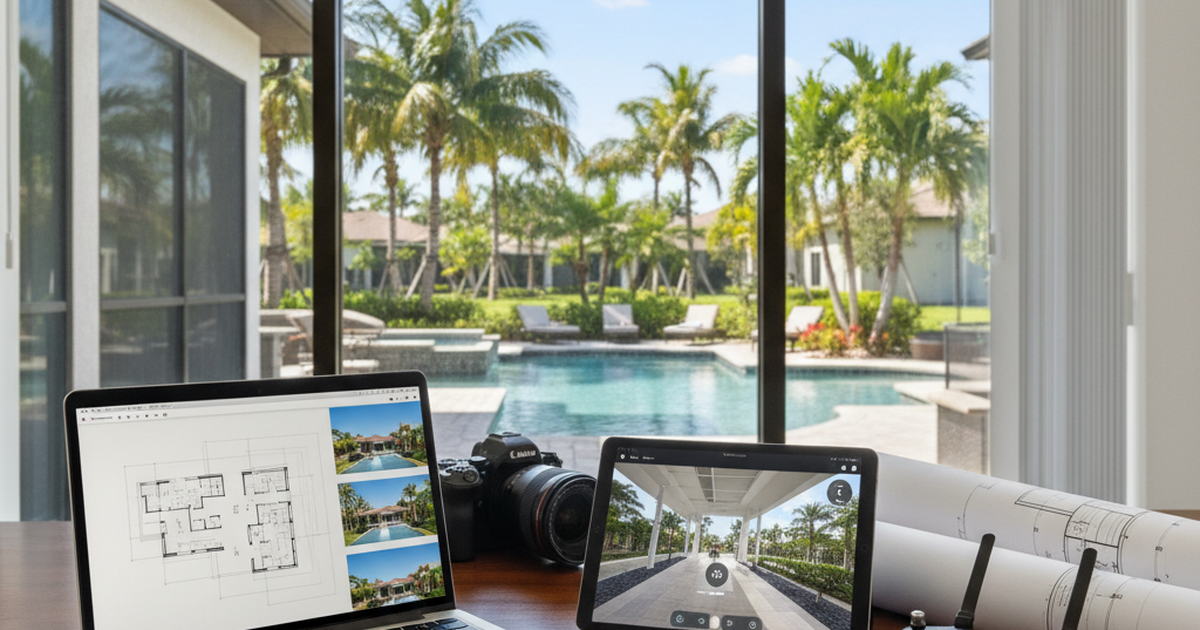
Data-First Listings in Florida: Why Floor Plans and Virtual Tours Matter in 2026
Florida agents are entering summer 2026 with a market that is active again but still selective. The latest April 2026 statewide data from Florida Realtors reported year-over-year gains in closed sales and new pending sales, with single-family closed sales up 2.4% and condo-townhouse closed sales up 6.9% from April 2025. At the same time, inventory is no longer the simple story it was during the tightest pandemic years: single-family supply sat at 4.7 months, while condo-townhouse supply remained much higher at 8.9 months. That mix creates a practical marketing problem for agents: buyers are moving, but they are comparing carefully before they spend time on a showing.
In that environment, listing media needs to do more than make a home look attractive. It needs to answer the questions serious buyers ask before they call: What is the real layout? How does the kitchen connect to the living space? Is there a first-floor bedroom? How large is the primary suite? Where is the pool, dock, lanai, garage, or flex room in relation to daily living areas?
Professional HDR photography still carries the first impression. But in 2026, the stronger listing package is data-first: clean HDR photos, accurate room information, a floor plan, and a virtual or interactive tour when the property justifies it. For Florida listings, where lifestyle features, outdoor space, insurance concerns, remote buyers, second-home shoppers, and condo complexity often shape the decision, this level of clarity is no longer a luxury add-on. It is how agents help buyers decide faster and with more confidence.
Florida buyers are active, but the listing has to earn attention quickly
Florida Realtors' April 2026 report gives agents a useful starting point. Statewide single-family closed sales reached 24,129, up 2.4% year over year. Condo and townhouse closed sales reached 9,309, up 6.9%. New pending sales also moved higher, rising 8.0% for single-family homes and 14.7% for condos and townhouses. Those pending numbers matter because they typically point toward near-term closing activity.
Prices, however, were not moving in a runaway pattern. The statewide median single-family sale price was $420,000, up 1.8% from April 2025. The statewide condo-townhouse median held at $315,000, flat year over year. This is not a market where every listing can depend on urgency alone. Presentation, pricing, and buyer confidence all have to work together.
The inventory split is especially important for media strategy. A single-family home with 4.7 months of supply still has competition, but the condo-townhouse segment at 8.9 months of supply gives buyers more room to compare. In a comparison market, weak media becomes a filter. Buyers do not need to dislike the property; they only need uncertainty about the layout, scale, or condition to move on to the next listing.
That is why a data-first listing package should be treated as a conversion tool, not just a visual upgrade. Photos pull the buyer into the listing. Floor plans, measurements, and tours help the buyer decide whether the home is worth scheduling. The goal is not more clicks from everyone. The goal is better-qualified interest from buyers who understand the property before they arrive.
NAR data shows that listing photos are essential, but photos are not the whole decision
The National Association of Realtors' 2025 Profile of Home Buyers and Sellers reinforces the central role of online listing media. In the report's home search section, 52% of buyers found the home they purchased on the internet. Buyers searched for a median of 10 weeks, and NAR reported that finding the right property remained the most difficult task in the process.
The same report also ranked the online features buyers found useful during their search. Photos were the most powerful single asset: 81% of buyers rated photos as very useful. Detailed information about properties for sale followed closely at 77%. Floor plans were rated very useful by 57% of buyers, while virtual tours were rated very useful by 38%.
Those numbers should shape how Florida agents think about listing media. Photography is not optional; it is the entry point. But the strongest listing does not stop at a photo gallery. A buyer may love the living room image and still need to know whether the bedrooms are split, whether the office has privacy, whether the lanai connects naturally to the kitchen, or whether a condo layout feels efficient enough for full-time living.
This matters even more when buyers are relocating, shopping from out of state, narrowing properties before a weekend trip, or comparing many similar homes from a phone. A listing that combines polished HDR photography with accurate spatial information reduces friction. It helps the buyer move from "this looks nice" to "this could work for us."
Floor plans give buyers spatial certainty that photos cannot provide
Photos show condition, light, finishes, views, and emotional appeal. They are excellent at showing why a property feels desirable. But even the best photo set can struggle to explain how a home lives. Wide-angle images can make rooms feel larger than expected. A sequence of beautiful images can leave buyers unsure about how one area connects to another. A floor plan solves a different problem: it gives structure to the photo story.
For Florida real estate, that structure is especially valuable. A single-family home may need to show the relationship between the pool, lanai, kitchen, primary suite, garage, guest rooms, and outdoor entertaining areas. A condo may need to clarify balcony access, bedroom separation, storage, elevator proximity, and usable living space. A waterfront or golf community property may need to show how lifestyle areas connect, not just that those amenities exist.
CubiCasa's 2026 listing trends research, based on a small general-public survey of 34 respondents, found that buyers ranked accurate data and room measurements above simply adding more listing photos. The same research reported that including a detailed floor plan made 88.2% of surveyed buyers "definitely more interested" in scheduling a visit, and every respondent expressed interest in seeing an interactive tour. Because the sample is small and produced by a floor-plan provider, agents should not treat it as a universal market statistic. But it points in the same direction as the larger NAR data: buyers want clarity, not just quantity.
That clarity can improve the quality of showings. When a buyer has already reviewed the layout, they are less likely to arrive and immediately discover a disqualifying issue. The showing becomes less about basic orientation and more about confirming fit, condition, neighborhood, and pricing. For agents, that means fewer wasted appointments and better conversations with serious prospects.
Virtual tours work best when they answer a real buyer question
Virtual tours and interactive tours should not be added automatically to every listing without thought. They work best when the property has a layout, scale, view, or condition story that benefits from deeper exploration. For example, a larger home with split bedrooms, a guest suite, a second living area, a detached structure, or a strong indoor-outdoor connection can benefit from a tour that helps buyers understand flow.
For condos and townhouses, tours can help buyers compare similar units without waiting for an in-person visit. This is relevant in the current Florida condo-townhouse market because April 2026 supply was materially higher than single-family supply. When buyers have many units to compare, a clear digital experience can keep a listing in consideration longer.
The best use of a virtual tour is not to replace photography. It is to extend it. HDR photos should establish quality and emotion. The floor plan should explain the layout. The tour should allow the buyer to move through the spaces and test whether the layout matches their needs. Used together, these assets reduce ambiguity.
Agents should also keep authenticity in mind. Virtual and interactive media must represent the property accurately. If a room is virtually staged, edited, or shown in a way that could create confusion, the listing should be transparent. Buyer trust is hard to regain after a showing reveals that the online presentation was more imaginative than accurate.
Florida lifestyle features need precise visual context
Zillow's March 2026 home features research is useful because it highlights the kinds of amenities buyers are rewarding. Zillow reported that homes with a dock sold for 5.4% more than expected, outdoor kitchens for 4.4% more, outdoor showers for 4.3% more, waterfront homes for 3.0% more, and outdoor fireplaces for 2.8% more. Zillow also reported that turnkey homes sold for 2.9% more than expected, while fixer-uppers sold for 14% less.
These findings do not mean every Florida listing with a dock or outdoor kitchen will automatically earn the same premium. They are national Zillow research results, and pricing depends on location, condition, property type, insurance, HOA rules, flood exposure, and local buyer demand. But the research does show something relevant for listing media: lifestyle features and move-in-ready condition matter, and they must be easy to evaluate online.
For a Florida agent, this means the media package should make valuable features legible. A dock should not appear in one distant aerial image without context. An outdoor kitchen should be photographed clearly and connected visually to the lanai, pool, or living area. Waterfront exposure should be shown honestly, including orientation and surrounding context. A remodeled kitchen should be photographed with enough detail to support the "turnkey" claim. A floor plan should help buyers understand whether these features are convenient or merely present.
This is where HDR photography, drone media, and floor plans support each other. HDR images show light, finishes, and room quality. Drone images show lot orientation, water, community context, and proximity. Floor plans explain how those features relate to the daily use of the home. For higher-value Florida properties, the combination is stronger than any single asset.
What a data-first listing package should include
A strong 2026 Florida listing package should begin with professional HDR photography. The image set needs clean verticals, balanced windows, accurate color, and a sequence that helps buyers understand the property from arrival through main living areas, bedrooms, baths, outdoor space, and community or building context.
The second layer is accurate property information. Room names, room dimensions, square footage notes, HOA details, renovation highlights, roof or systems information when appropriate, and key lifestyle features should be consistent across the MLS, property website, brochure, and social content. The media cannot carry the listing if the written details are vague or inconsistent.
The third layer is a floor plan. For many listings, a clean 2D floor plan is enough. It should show room relationships, major fixtures, entries, garages, balconies, lanais, and outdoor connections where possible. For complex properties, new construction, luxury listings, or homes marketed to remote buyers, a more visual plan or interactive layout may be worth the extra effort.
The fourth layer is selective virtual or interactive media. This could be a 3D tour, a room-linked tour, a walkthrough video, or an interactive floor-plan experience. The format matters less than the buyer question it answers. If the tour helps buyers understand flow, scale, finishes, view, or condition, it has a clear role. If it simply duplicates the photo gallery, it may not be the best use of budget.
The fifth layer is aerial context when the property calls for it. Drone photography is especially useful for waterfront homes, acreage, corner lots, communities with amenities, construction or development sites, and properties where access, surroundings, roof visibility, or lot layout affects buyer perception.
How agents should decide what each listing needs
Not every listing needs the same package. A small, straightforward property may be well served by HDR photos and a clean floor plan. A waterfront home may need HDR photography, drone images, twilight exteriors, a floor plan, and a short lifestyle video. A condo in a competitive building may need clear interior photos, balcony-view images, building amenities, a floor plan, and an honest explanation of layout efficiency. A builder or developer may need progress photography, aerial context, and visual assets that can be reused across pre-sale, leasing, lender updates, and investor communication.
The decision should come from the buyer journey. Ask what the buyer must understand before a showing. If the answer is "layout," add a floor plan. If the answer is "flow," consider a tour. If the answer is "location and surroundings," use aerial media. If the answer is "condition and finishes," invest in stronger HDR photography and detail shots. If the answer is "confidence," make sure the media and description match exactly.
Agents should also consider market segment. In a faster-moving entry-level single-family segment, the goal may be to launch cleanly and capture serious attention in the first few days. In a higher-inventory condo segment, the goal may be to keep buyers engaged long enough to understand why one unit is different from another. In luxury or waterfront, the goal may be to communicate lifestyle value without exaggeration.
The practical payoff: better showings, cleaner expectations, and stronger seller conversations
A data-first listing package helps buyers, but it also helps agents manage sellers. Sellers often ask why professional media costs more than a basic photo shoot. The answer is that the listing is not competing only against nearby homes; it is competing against every other property the buyer can compare instantly. Professional media creates the first impression. Accurate data keeps the buyer engaged. Floor plans and tours reduce uncertainty. Drone context explains value that ground-level photos may miss.
It also improves expectation-setting. When online media is clear, buyers arrive with a better understanding of the property. That does not guarantee an offer, but it can reduce mismatched showings and improve the quality of feedback. A buyer who rejects a property after reviewing a floor plan may actually save the seller and agent time. A buyer who books a showing after reviewing the full package is usually further along in their decision process.
For Florida agents in 2026, this is the practical case for pairing HDR photography with floor plans and virtual tours. The market is not simply about creating more content. It is about creating the right evidence for a buyer who is comparing carefully. The listing that explains itself clearly has a better chance of being saved, shared, toured, and taken seriously.
Conclusion
Florida's 2026 market is giving agents opportunity, but it is also asking for better precision. Buyers are active, yet they are selective. They rely heavily on online information, and they expect listing media to help them understand both the feeling and the facts of a property.
HDR photography remains the foundation. But the listings that stand out are increasingly the ones that combine beauty with clarity: accurate details, floor plans, virtual or interactive tours when useful, and aerial context when the property benefits from it. For agents, brokers, builders, and developers, that combination turns media from a checklist item into a decision-support tool.
If you are preparing a Florida listing and want a media package built around buyer clarity, Property HDR can help with HDR photography, drone media, floor plans, virtual tour assets, and listing-ready visual documentation.
Request a Quote to plan the right media package for your next Florida listing.
Sources
Florida Realtors. (2026, May). Fla.'s Housing Market: Closed and New Pending Sales Rise in April. https://www.floridarealtors.org/newsroom/flas-housing-market-closed-and-new-pending-sales-rise-april
Florida Realtors. (2026, May). Florida home sales rise again in April. https://www.floridarealtors.org/news-media/news-articles/2026/05/florida-home-sales-rise-again-april
National Association of Realtors. (2025, November). 2025 Profile of Home Buyers and Sellers. https://www.nar.realtor/sites/default/files/2025-11/2025-profile-of-home-buyers-and-sellers-highlights-11-04-2025.pdf
Zillow. (2026, March 24). Cottagecore, customization and quartzite: Zillow's 2026 home features that sell for more. https://zillow.mediaroom.com/2026-03-24-Cottagecore,-customization-quartzite-Zillows-2026-home-features-that-sell-for-more
Zillow Research. (2025, December). Zillow's 2026 Housing Market Predictions. https://www.zillow.com/research/2026-housing-predictions-35800
CubiCasa. (2026). Real Estate Listing Trends in 2026: Why Data Beats Photo Quantity. https://www.cubi.casa/real-estate-listing-trends-2026