Build-to-Rent in Florida: Why Developers Need Aerial Progress Media Before Lease-Up
Build-to-rent is no longer an experimental corner of residential development. In Florida, it now sits inside a more complicated 2026 market: renters still want single-family space, developers still see demand in growing Sun Belt communities, and lenders are asking harder questions about execution, absorption, and risk. That combination makes visual documentation more than a marketing extra. For build-to-rent teams, aerial progress media can become a practical record of what is being built, how the site is advancing, and whether the community is ready to support leasing conversations before every home is complete.
The timing matters. NAHB reported on May 25, 2026 that single-family built-to-rent starts slowed at the start of 2026, with roughly 14,000 starts in the first quarter, down from about 19,000 in the first quarter of 2025. Over the last four quarters, NAHB estimated 62,000 starts, a 26% decline from the prior four-quarter period [1]. That is not a collapse, but it is a reset. In a market where financing costs, policy uncertainty, and competing rental supply are all part of the conversation, developers need cleaner ways to communicate progress to capital partners, municipalities, property managers, brokers, and future residents.
For Property HDR clients, the lesson is straightforward: if a project depends on confidence before completion, the media plan should start before the leasing campaign. Scheduled drone photography, construction progress photos, short update videos, and site context imagery give the team a verified visual record while the project is still moving. That record can support internal reporting, investor updates, pre-leasing material, and launch content without waiting until the last week before opening.
Build-to-rent is cooling, but it is still structurally larger than before the pandemic
The strongest argument for planned documentation is not that build-to-rent is expanding without friction. It is that the sector has become large enough to require professional systems, even as growth normalizes.
Harvard's Joint Center for Housing Studies reported in its 2025 State of the Nation's Housing report that roughly 93,000 single-family rentals were started in 2024, a record high and more than double the roughly 40,000 started in 2019. The same report noted that single-family units made up an all-time high of 22% of rental starts in 2024, and that more than 14.2 million renter households lived in single-family homes at last measure in 2023 [2]. That makes the category too important to treat like a small niche.
At the same time, 2026 is less forgiving than the boom years. NAHB's May 2026 analysis says the current four-quarter moving average for single-family built-for-rent market share is just under 7%, still well above the historical average of 2.7% from 1992 to 2012, but the group also expects near-term construction to be slow because of market and policy headwinds [1]. Arbor's Q1 2026 Single-Family Rental Investment Trends Report reached a similar conclusion from a capital-markets angle: build-to-rent remained elevated by historical standards, but starts had pulled back from the 2024 peak [3].
That is exactly the kind of environment where visual proof becomes useful. When capital is more selective, a developer cannot rely on broad market enthusiasm alone. Aerial documentation can show that roads are cut, pads are poured, vertical construction is underway, amenities are tracking, landscaping is moving, and access points are usable. It turns a spreadsheet update into a physical record that stakeholders can understand quickly.
Florida has active BTR projects, and many are spread across fast-growing secondary markets
Build-to-rent demand is not limited to one Florida metro. In February 2026, Homes.com News reported that Jacksonville-based Southern Impression Homes had seven built-to-rent communities under construction across Central and North Florida, totaling more than 1,000 planned rental homes. The announced communities included projects in Daytona Beach, Gainesville, Orlando, Tampa, Ocala, Wildwood, and Jacksonville [4].
That geography matters for media planning. A scattered pipeline across several markets creates a coordination problem. Regional executives, investors, lenders, and marketing teams may not be visiting every site every week. Property managers may need early visual assets before the full leasing office is ready. Brokers may need to explain the surrounding neighborhood, access roads, schools, retail corridors, and nearby employment centers before prospects can tour a finished product.
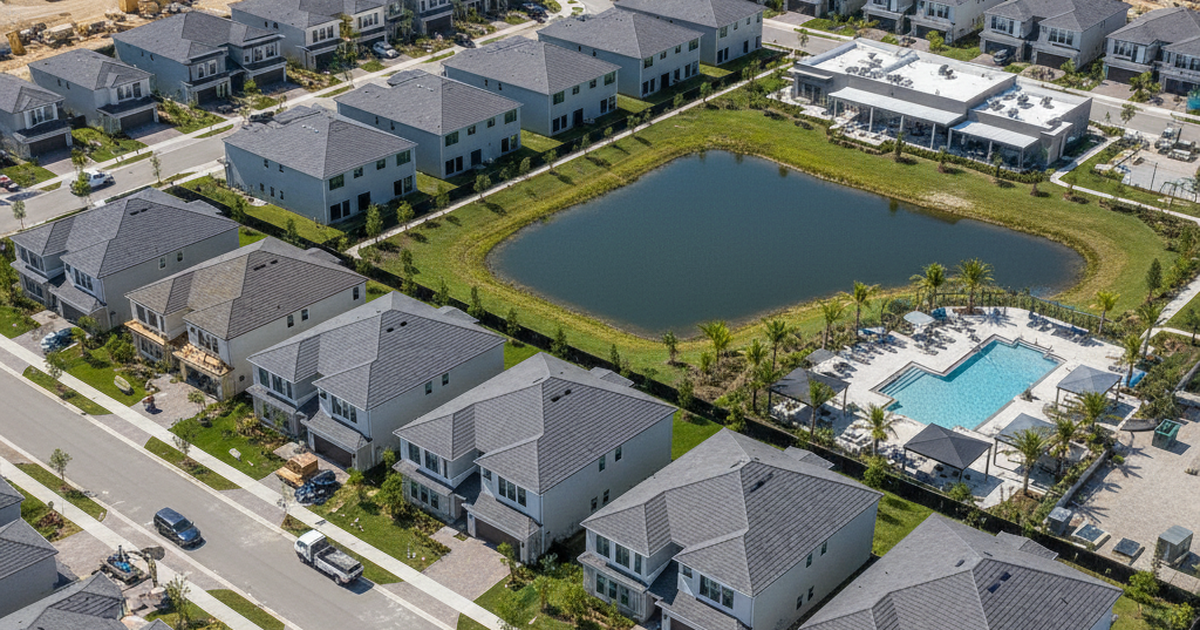
Aerial progress media helps because it captures both the project and the context. For a BTR community, the surrounding environment is part of the value proposition: commute routes, nearby shopping, retention ponds, trails, amenity placement, open space, parking, unit spacing, and the relationship between homes and shared facilities. Ground photos can document materials and interiors, but aerial views show how the community works as a whole.
Florida's broader housing market also gives developers a reason to be specific. Florida Realtors reported that in April 2026, existing single-family closed sales rose 2.4% year over year and condo-townhouse closed sales rose 6.9%, while single-family inventory sat at a 4.7-month supply and condo-townhouse inventory at an 8.9-month supply [5]. Those numbers describe an active but uneven market. For BTR operators, that means resident demand, resale competition, and rental alternatives can vary sharply by property type and submarket. Generic launch content is weaker than site-specific visual evidence.
Lease-up risk makes early media more valuable
The rental market is still healthy in many places, but the operating environment is more competitive. NAHB said in February 2026 that the rental market had slowed after the pandemic-era boom, with high supply pushing multifamily rents down 1% year over year and single-family rent growth slowing. The same NAHB release specifically identified Tampa among supply-rich metros where rents weakened [6].
Arbor's Q1 2026 report showed why the picture is mixed rather than negative. It reported that single-family rental occupancy across all SFR property types averaged 94.0% in the fourth quarter of 2025, near long-run averages, while national SFR rent growth had normalized to 2.6% year over year in January 2026 based on Zillow data [3]. In plain terms, the category still has demand, but operators cannot assume every project will lease itself at aggressive rents.
That changes how developers should think about photography and video. Waiting until completion compresses too much work into the final phase: final exterior photography, amenity photos, model-home photography, drone hero shots, social clips, website assets, broker packets, investor recap images, and progress closeout documentation. If a project needs to build a waitlist or communicate momentum before all units are complete, that timing is too late.
A better approach is to build a media cadence around development milestones. Early aerials document the raw site, access, grading, and surrounding context. Mid-construction flights show vertical progress, rooflines, streets, amenities, and unit clusters. Pre-opening media can focus on finished exteriors, landscaping, clubhouse or amenity areas, model homes, leasing signage, and neighborhood approach shots. By the time the first lease-up push begins, the marketing team already has a sequence of credible visuals instead of a single last-minute shoot.
Progress documentation should serve operations, not just marketing
The most useful BTR media plan is not only a gallery for the website. It is a record that different teams can use for different decisions.
For ownership and capital partners, consistent aerial progress photos help show whether the site is moving in line with reported milestones. For construction teams, drone imagery can support weekly or monthly progress records, vendor coordination, access planning, and punch-list context. For property management, early visuals help teams understand unit phasing, parking, amenities, signage, and resident flow. For marketing and leasing, the same documented progress can become launch content that feels factual rather than overproduced.
The distinction matters because buyers and renters are increasingly sensitive to visual accuracy. Property HDR has already covered photo authenticity in real estate listings, and the same principle applies here: the goal is not to make an unfinished community look finished. The goal is to communicate clearly what exists now, what is under construction, and what the finished experience is expected to be. Honest progress media can build confidence because it reduces ambiguity.
Drone documentation is especially useful on horizontal projects because the camera can show phasing. A ground-level photo may show a row of framed homes. An aerial image can show whether that row is part of the first phase, how far it sits from the entrance, whether roads and utilities appear complete around it, and how much work remains between current progress and the leasing story. That is operational information, not decoration.
What a Florida BTR media cadence should include
A practical cadence does not need to be complicated. The right schedule depends on the project size, construction pace, and lease-up date, but most Florida BTR projects can start with a monthly or milestone-based structure.
First, capture a baseline aerial set before major vertical progress. This gives the team a reference point for site layout, access, adjacent roads, nearby retail, water features, open space, and the relationship between the community and surrounding development. It also gives marketing a context library long before finished homes are ready.
Second, capture recurring progress flights during grading, infrastructure, vertical construction, roofing, exterior finishes, amenity work, and landscaping. These sessions should be shot from repeatable angles when possible so stakeholders can compare progress over time. Wide aerials are useful for the whole community, while tighter drone views can focus on construction zones, model clusters, amenity buildings, and completed streets.
Third, add ground-level construction photos when the story shifts from land development to resident experience. Interior model photography, exterior streetscape photography, amenity photos, twilight exteriors, and short social video clips should enter the plan before the main lease-up campaign. Aerial media shows scale; ground media shows livability.
Fourth, create a clean handoff library. Developers often lose value because project media lives across email threads, phones, contractor folders, and ad hoc downloads. A professional media package should be organized by date, phase, and use case: investor reporting, construction record, leasing launch, website, paid social, broker outreach, and owner archive.
Finally, keep the language around the visuals precise. If a drone image shows ongoing construction, label it as progress. If a rendering is used, identify it separately from photography. If a finished model home is photographed before the rest of the community is complete, make that distinction clear in marketing materials. In 2026, trust is part of the product.
How Property HDR fits the BTR workflow
Property HDR's service mix maps well to the build-to-rent lifecycle because BTR projects need both construction documentation and finished-property marketing. Aerial and drone photography can document site progress, surrounding context, phasing, and community scale. Property inspection photos can help create condition records for specific areas or milestone documentation. Real estate photography, floor plans, virtual tours, and property video can support model homes, leasing pages, broker presentations, and launch campaigns.
The key is to plan the media before the project reaches the marketing emergency stage. If a developer waits until the leasing team needs assets tomorrow, the result is usually a narrow shoot list focused only on finished areas. If the media plan begins earlier, the same project can produce a stronger archive: early site context, visible progress, finished streetscapes, models, amenities, and a clear story of delivery.
That story is especially valuable in Florida because many BTR projects are not only selling homes; they are selling a managed community lifestyle in a specific place. Aerial views can show proximity to employment corridors, retail nodes, schools, parks, golf communities, coastlines, lakes, or suburban growth areas. Ground-level HDR photography can then show the finishes, layouts, and resident-facing details that make the project feel real.
Conclusion: in 2026, BTR media should reduce uncertainty
Build-to-rent remains a meaningful part of the housing landscape, but 2026 is not a year for vague progress updates. Starts have cooled from the 2024 peak, financing is more selective, rental supply is uneven across metros, and Florida projects are competing for attention from residents, capital partners, and local stakeholders.
Aerial progress media gives developers a simple advantage: it makes the project visible before completion. It documents what has been done, supports more transparent reporting, gives leasing teams real assets earlier, and helps stakeholders understand the community in context. For Florida BTR teams planning 2026 launches, the media calendar should be treated as part of the development plan, not an afterthought.
Request a Quote from Property HDR to plan aerial progress photography, construction documentation, model-home media, and launch-ready visual assets for your Florida build-to-rent project.
Sources
National Association of Home Builders, Eye on Housing. (2026, May 25). Single-Family Built-to-Rent Slowed at Start of 2026. https://eyeonhousing.org/2026/05/single-family-built-to-rent-slowed-at-start-of-2026/
Joint Center for Housing Studies of Harvard University. (2025). The State of the Nation's Housing 2025. https://rihousing.com/wp-content/uploads/2026/01/Harvard_JCHS_The_State_of_the_Nations_Housing_2025.pdf
Arbor Realty Trust. (2026, Q1). Single-Family Rental Investment Trends Report. https://arbor.com/wp-content/uploads/2026/03/Arbor_Single_Family_Invest_Rental_Report_2026-Q1.pdf
Homes.com News. (2026, February 12). Southern Impression Homes plans seven built-to-rent communities in Central and North Florida. https://www.homes.com/news/southern-impression-homes-plans-seven-built-to-rent-communities-in-central-and-north-florida/352285205/
Florida Realtors. (2026, May). Fla.'s Housing Market: Closed and New Pending Sales Rise in April. https://www.floridarealtors.org/newsroom/flas-housing-market-closed-and-new-pending-sales-rise-april
National Association of Home Builders. (2026, February 17). Multifamily Market Expected to Cool in 2026 as Vacancies Rise. https://www.nahb.org/news-and-economics/press-releases/2026/02/multifamily-market-expected-to-cool-in-2026-as-vacancies-rise
U.S. Census Bureau and U.S. Department of Housing and Urban Development. (2026, May 21). New Residential Construction: April 2026. https://www.census.gov/construction/nrc/pdf/newresconst.pdf